Thursday, May 19, 2011


Monday, January 31, 2011
Molly's First Deer

Molly at 12 months old, with her first deer was never "trained" to be a blood tracking dog. She is as we say "a natural".
She was imprinted on blood, eating raw beef livers at my house starting at 3 1/2 weeks old for about a month or two before I gave her to Scott and his family to be their family ranch pet.
Below are a couple of pictures of Molly at about six months old, last summer.

Notice the loyalty and devotion in the photo below.

She just found her first deer this past weekend, and I will post those pictures in here along with some of her mother Scarlet which I shot in good light on a track about 2 weeks ago.
But, Molly found her deer after dark, and I was not there to photo, so Molly's owner, Scott, sent the hunt photos to me in an email and I pulled some more off the www.bayoubucks.com site.
The photo below and the other daylight shots are of Molly's mother on a track a few weeks ago in the same terrain. I am inserting those shots in the email for illustration and education purposes.

Scott just sent me an email of Molly's first deer with pictures.
I want to use this email to explain how a Catahoula works a blood trail.
The (enclosed inserts) are mine, to help explain what is happening.
-------------------------------------------------------------------------------------
Here is the email Scott sent me this morning:

Molly’s First Find.
It was a short track, but we lost the blood the last 20 yards(before the deer),

which does not sound very far, but(in the dark), the palmettos were so thick that you couldn't see five yards in front of you.

I tried to let her work on leash, but it was too thick, so I turned her loose.

She does really well. While on track, she does not leave you behind, she will stop and actually let you catch up(check back), then continues back on track.

We are both new at this, but I think with a little time and practical experience, she will be a good asset(blood tracker).

Jeremy was so happy, he was generous enough to give us a third of his deer meat.(better than giving the cayotes a chance)

I have to be careful because, I guess she thinks that since she found it, the deer belongs to her, and she gets very possessive(protective, guarding the kill).
 Molly guarding the meat!
I had to put her leash back on, so they could drag the deer out.(She will relax in time, we hope!)
Jeremy Lemieux posted his story on the Bayou Bucks.com forum.
-------------------------------------------------------------------------------------
The link in the last line above will take you to the hunters post on bayoubucks.com(BTW, my forum handle there, is "catahoula1".
Now let's learn something about the Catahoula breed;
What Is A "Check Back"?
For those of you new to the Catahoula breed, you need to understand that a Catahoula Cur, especially a young one, will not go very far without you. If they know you are following them and you are close behind, they will keep moving forward. If you don't keep up, they will turn around on track and "check back".

Meaning, they will come back to you and make sure you are following their lead. When following a blood tracking dog, always trust the dog. If they do check back, do not give up, get anxious or get mad, you should reward them with a pat on the head, and praise them verbally; saying good dog, now go find the deer, blood trail, blood trail, find me some blood, come on dead deer!(get excited, be happy, and start moving forward again), and they usually turn around and continue tracking in front of you. (If they do not check back, they are most likely guarding the kill)

Catahoulas are naturally curious about new scents, and every blood trail is a new and unique scent to be explored and followed. This is natural instinct as a result of breeding, not training. Another natural instinct is protectivity.
Catahoulas Are Natural Protectors
And what that means is, they are by natural instinct, loyal and protective, and are not aggresive unless they feel that what they are bonded to and guarding(such as your family, property, or your deer!) is threatened, by an intruder. I suggest you spoil them rotten as a puppy and provide for and protect them when they are young and they will grow up to want to do the same for you for the rest of their life.
 An 8 week old puppy bonding to her "new" momma!
You do not need to teach a well bred Catahoula to be protective or aggresive. It is bred into them and it will surface in a flash when needed. You need to protect your dog from getting himself and you in trouble as a puppy in the first year or two by working him on leash so you have control of him. The first and most important things to teach a Catahoula is obedience and ease of handling on leash, and hope he learns to socialize and warm up to people along the way, so he can be worked off leash, and not be a threat to people.
Now, when they find the deer, Catahoulas are often very protective of the kill. They will growl at anyone(excet their master and family), who gets too close to the deer.

A 10 week old puppy and "her" first deer!(same puppy of the previous photo)
They found it, and it is their deer until the master gets there. DO NOT try to over-ride the dogs position if you are not the owner of the dog. He or she is growling to give you fair warning. Back off, or you will get bit!
And, do not fuss at them for being protective. You(if you are the owner of the dog), should leash them and tie them back away from the deer, before the hunter gets there. If you are using your dog to track for someone else's deer, while tracking, I suggest you stay about 20-30 yards behind the dog, and the hunter about 10-30 yards behind you.
If you(or anyone), beat the dog for eating on or protecting the kill(that's her job), you may cause the dog to be afraid of tracking deer again. You can ruin a good blood dog in one night. Also be careful not to let anyone be too harsh on the dog(verbally or physically), for anything wrong(especially for puppies), anywhere around the deer, at the kill site, during transport, or in the skinning shed.
I advise you to let the dog be present at all of the above if possible. Best to tie them up with a cable lead(they can't chew through it), and let them be there in the skinning shed so they can watch and get treats, without the freedom to get in trouble. If you can't control the dog verbally or by tying nearby with a cable lead, and they continue to get in trouble anyway, and be fussed at anywhere around the deer, remove the dog to a secure area away from the deer. What you want the dog to experience is a totally feel good, positive re-enforcement, team work association, any time it is around a dead deer and receive some meat treats at the skinning and Bar-be-que if possible. Reward and praise them constantly in pursuit of and after the recovery of lost deer. A tracker should always be as close as possible to the dog in pursuit of a fresh track, so the dog does not have to check back too often. Then, in case the deer is jumped and charges the dog with his antlers down, be prepared to defend your dog and yourself with a pistol or shotgun when tracking big bucks.(if legally allowed)
If the deer is gutted at the kill site, give the dog some liver on site and save liver, kidneys, heart, sleen and lungs for later. I always let my dogs eat all they want of any innards at the kill site,
 A 12 and 16 week old Catahoula puppy in the skinning shed.
and later, they can have everything including head, feet, skin, deboned carcuss, etc. after the deer is processed.
If your dog eats some choic meat when you are not looking, don't fuss too much, because it is not his fault, it is your fault that you left the meat there, where he could get to it, if he wasn't tied. It is very important that the dog be there in the skinning shed, but be secured by lead or in a crate, so they can't get in trouble.
Being too harsh and punishing the dog around a dead deer, could ruin your dogs motivation to find deer in the future. I have seen dogs be turned off to deer permanently, by someone who did not even own the dog, but was pissed to find the dog's head in their ice chest of meat, or being mad at the dog for protecting and growling at them for getting too close to the kill before the dog owner got there.
Dogs often associate rewards and punishment in a much larger picture than we are aware of. This may not apply to other breeds, but it is an important asset in the Catahoula when properly understood, valued, and handled. Please consider that your Catahoula will guard your kill should the cayotes show up and try to muscle in on the kill before you can get there, and Catahoulas are known for tackling and catching a deer by the throat and killing it, if it tries to get up and run should you jump it while tracking blood.
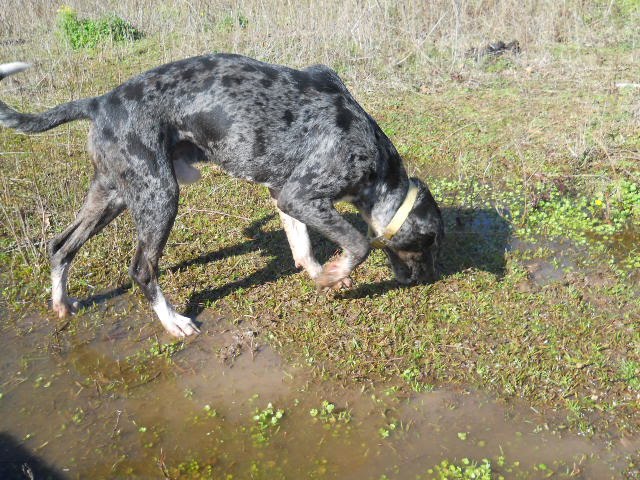
All of these natural abilities to protect and control the final destination of the meat to the leader of the pack(his master), are due to a Catahoulas' loyalty and grit. This may be a dog breed which is way too "high performance" and "aggressive" for most people, but if you think you can handle them, and you like the idea of having a natural protector around as your family pet, they are in my opinion, the ultimate short range, blood tracking dog.
Thursday, January 20, 2011
A Blood Trail Dog Testimonial 2 1/2 Months Old?
 This is Valerie at 8 weeks old, a sister to the puppy Sandy bought from me.
 Sandy and his son on opening weekend or there abouts.
I delivered Catahoula puppies to Florida a couple of weeks ago and already, I am getting positive reports that these puppies are trying to find the deer and they are only 10, 12 and 16 weeks old!
If he gives me permission to refer people to him as a reference of my Catahoula dogs abilities, I'll put his email and phone number in another post soon.
I'm sure he will be sending me some more photos and testimonials soon.
------------------------------------------------------------------------------------
Here is the email Sandy sent me.
A friend shot a doe Tuesday evening and called me to bring the puppies. He said he had blood on the arrow but couldn't find a blood trail. I told him to back off and I'll bring the dogs.
We arrived and took the puppies into the site where his arrow was sticking in the ground. All 3 puppies went straight to the arrow and the little brown female (Tracer) took off with her nose down. The others followed close behind.
We found visible blood after about 50 yards and then it was just a drop here and there. The puppies moved thru the block (very thick vegetation) and eventually lost the trail. I couldn't find anymore blood.
We came out of the block on a dim road covered with grass and leaves, I turned them to the left and walked slow watching them work. After about 40 yards all 3 converged on the side of the road, I walked over and found a single leaf with a small drop of blood.
By now we were over 1/4 mile from where the deer was shot. We never found the deer and never found anymore blood.. But for 2 1/2 month old puppies, I can't be more pleased at this point.
-------------------------------------------------------------------------------------
Wow! GOOOOO Sandy!
After Sandy and his son lost a 10 point at the beginning of the season, he called me about purchasing Catahoula puppies to use for blood trail.
We began to talk about getting him some of my puppies as soon as they were old enough to wean, and then the holidays were rolling in, and the puppies were 8 weeks before I could deliver. In the meantime, I am bringing deer blood and carcusses home to start the puppies and I do this for all my puppies no matter the age. The more blood, in the woods or my yard, the better.
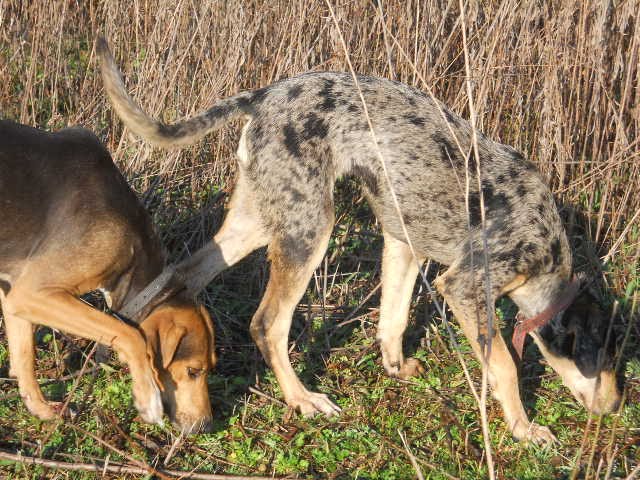
The lesson here: do not under-estimate a dogs tracking abilities based upon age or experience or the lack there of.
Have faith in your dog, trust in their superior abilities and give them a chance
.
Bring them to as many blood trails in the woods if it is hunting season, and make as many in your yard as you possibly can, no matter what the age of the dog, work them.
So, when do you start blood trail training? When the pups are about 3 1/2 weeks old.
Start feeding them raw beef, goat, sheep, deer meat, or raw liver, and start hauling them to the woods or fields where you hunt. If it is not hunting season, bring some raw liver to a new location, and a string to drag and make a mock trail. Don't let the puppy see you making the trail. Change locations as much as possible. Or change direction if you are doing this at your feeder and hunting stand, ideally about once a month. The sooner you can make long trails and increase the complexity of the trail, the better.

Create complexities and increase difficulty as in crossing water and making 90' turns or make an intermittant trail.
Here is another thing. Don't just always put dog food in a feed bowl by the back door. Spread out kibble once in a while around the yard or in a field. Make your puppy use his nose to locate food if he wants to eat! Keep it close and compact when they are young and gradually extend the exercise into a hundred yards or more. Make them hunt if they want to eat! If they don't put their nose down to hunt, and follow a line of kibble, they don't eat! Just think about it. It doesn't have to be blood.
And don't forget about using roadkill in the off season to tune up your pups.

This is Marcus de la Houssaye, and I want to remind you;
Be safe, keep it legal, and good luck.
Subscribe to:
Posts (Atom)