Thursday, January 20, 2011

A Blood Trail Dog Testimonial 2 1/2 Months Old?

This is Valerie at 8 weeks old, a sister to the puppy Sandy bought from me.


Sandy and his son on opening weekend or there abouts.


I delivered Catahoula puppies to Florida a couple of weeks ago and already, I am getting positive reports that these puppies are trying to find the deer and they are only 10, 12 and 16 weeks old!

If he gives me permission to refer people to him as a reference of my Catahoula dogs abilities, I'll put his email and phone number in another post soon.

I'm sure he will be sending me some more photos and testimonials soon.

------------------------------------------------------------------------------------


Here is the email Sandy sent me.


A friend shot a doe Tuesday evening and called me to bring the puppies. He said he had blood on the arrow but couldn't find a blood trail. I told him to back off and I'll bring the dogs.

We arrived and took the puppies into the site where his arrow was sticking in the ground. All 3 puppies went straight to the arrow and the little brown female (Tracer) took off with her nose down. The others followed close behind.

We found visible blood after about 50 yards and then it was just a drop here and there. The puppies moved thru the block (very thick vegetation) and eventually lost the trail. I couldn't find anymore blood.

We came out of the block on a dim road covered with grass and leaves, I turned them to the left and walked slow watching them work. After about 40 yards all 3 converged on the side of the road, I walked over and found a single leaf with a small drop of blood.

By now we were over 1/4 mile from where the deer was shot. We never found the deer and never found anymore blood.. But for 2 1/2 month old puppies, I can't be more pleased at this point.

-------------------------------------------------------------------------------------

Wow! GOOOOO Sandy!

After Sandy and his son lost a 10 point at the beginning of the season, he called me about purchasing Catahoula puppies to use for blood trail.

We began to talk about getting him some of my puppies as soon as they were old enough to wean, and then the holidays were rolling in, and the puppies were 8 weeks before I could deliver. In the meantime, I am bringing deer blood and carcusses home to start the puppies and I do this for all my puppies no matter the age. The more blood, in the woods or my yard, the better.

The lesson here: do not under-estimate a dogs tracking abilities based upon age or experience or the lack there of.

Have faith in your dog, trust in their superior abilities and give them a chance
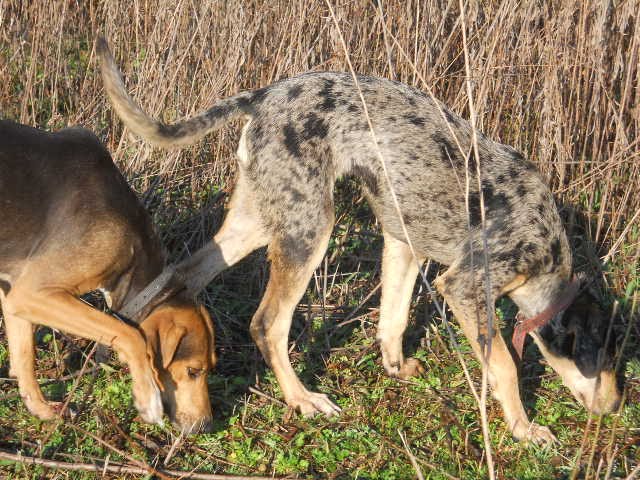


.

Bring them to as many blood trails in the woods if it is hunting season, and make as many in your yard as you possibly can, no matter what the age of the dog, work them.

So, when do you start blood trail training? When the pups are about 3 1/2 weeks old.

Start feeding them raw beef, goat, sheep, deer meat, or raw liver, and start hauling them to the woods or fields where you hunt. If it is not hunting season, bring some raw liver to a new location, and a string to drag and make a mock trail. Don't let the puppy see you making the trail. Change locations as much as possible. Or change direction if you are doing this at your feeder and hunting stand, ideally about once a month. The sooner you can make long trails and increase the complexity of the trail, the better.


Create complexities and increase difficulty as in crossing water and making 90' turns or make an intermittant trail.

Here is another thing. Don't just always put dog food in a feed bowl by the back door. Spread out kibble once in a while around the yard or in a field. Make your puppy use his nose to locate food if he wants to eat! Keep it close and compact when they are young and gradually extend the exercise into a hundred yards or more. Make them hunt if they want to eat! If they don't put their nose down to hunt, and follow a line of kibble, they don't eat! Just think about it. It doesn't have to be blood.

And don't forget about using roadkill in the off season to tune up your pups.


This is Marcus de la Houssaye, and I want to remind you;

Be safe, keep it legal, and good luck.

Monday, January 17, 2011

Learning From Our Experiences

After only one season as a professional blood tracker, I am convinced we deer hunters need to do a little more practice at the paper target in the off season and study deer anatomy and consider shot placement as a serious issue that needs to be addressed by all of us.

OK, here is yours truly admitting that I missed 3 out of 5 shots so far this deer hunting season. OK? I am not pointing blame at anyone. We are in this together.

Now, that I have confessed my own inaccuracies, the last 4 tracks I went on with my dogs were apparently not mortal wounds. OK, so it is not just me that needs better shot placement. More so, we can all learn a lot about tracking wounded deer. This is a learning process, and we would all do well to hunt with our youth and old timers as much as possible, to share the knowledge these old timers bring to the sport.

Hey, I am happy these people who called me were willing to bring in some help and see if the dog could find the deer. We found one, but problem was it got up and ran like a bat out of hell. I believe this deer will survive!

Later I overheard the hunter talking about putting the cross hairs on the shoulder and I thought, "You are supposed to but the cross hairs "behind" the shoulder.

Anyway, apparently John Jeanneney believes as I do that we need to tighten up and work harder to prevent the loss of so many wounded deer during hunting season.

Below is an introduction to his new book.

Dead On! is written for all deer hunters. They need information useful for killing deer quickly, cleanly and humanely, and they need to know the best tactics for finding deer on their own if complications do arise. The book questions many of the traditional assumptions about how to find wounded deer after the shot. John Jeanneney comes to the subject with a fresh perspective based upon his 930 searches with bow and gun hunters to find their deer. He used leashed tracking dogs to follow wounded deer far beyond the hunters’ points of loss, and this yielded more complete information on wounded deer behavior than has been presented by previous authors. Jeanneney presents this information in the form of clear, practical advice to hunters who do not have access to a tracking dog.

If you would like to order his book as I have just done, you can go to his site at:

www.deadonbook.com

and here is a link to a page in the site titled: About This Book

Below is the content from that page

Excerpt from Dead On!

For 34 years I have been tracking wounded deer on a volunteer basis. By the end of 2009 I had gone out on 930 searches with my tracking dogs to help hunters. They had tried everything to find their deer before they called me. We found many of these deer, 253 to be exact, and we usually learned something, even if the deer was not seriously wounded, and we could not catch up to it. This book is written to share with you what was learned during these many days and nights in the woods. You do not need a tracking dog to use this information!

My earlier book, Tracking Dogs for Finding Wounded Deer, describes what the dogs helped me learn about wounded deer behavior. On many occasions the dog’s work allowed us to figure out what the wounded deer had done. As the dog followed the scent line, it pointed out the widely separated bits of visual sign far beyond the hunter’s point of loss. Most of the deer we did not find provided convincing evidence that they were going to survive. Win or lose, the hunter usually felt better after we were finished. Even if we did not have the venison and the antlers, he knew that the deer was not going to waste.

The tracking dog book has sold beyond my wildest expectations, and many of the readers’ comments have echoed these words by Will Elliott: “The abundant wealth of this book lies in what it can do for a hunter before he goes out hunting and wounds a deer. Once a deer has been wounded, Jeanneney’s suggestions become priceless for identifying wound sites and tracking approaches before making that call to a Deer Search volunteer handler. Chapters 12-14 alone would be worth the $24.95 price of this book.”

This new and smaller book is designed to provide that information, and more, for the majority of deer hunters, who do not have the time or the interest to develop a tracking dog for themselves. They simply need information useful for killing deer quickly, cleanly and humanely, and they need to know the best tactics for finding deer on their own if complications do arise.

As you read this book you will see that my work with tracking dogs taught me many lessons that contradict the traditional lore about finding wounded deer. I had the advantage of learning what happened beyond the hunter’s point of loss.

I love to tell and write “deer finding” stories, but too many of these tales can get in the way of presenting clear principles that can be applied in the woods. I want this to be a small book that you can read on the deer stand after 10 AM, once your fingers have warmed up enough to turn the pages. As a former student, and later a teacher, I learned that it is easier to retain information, if you understand why it is true. Without getting into a lot of technical details, I plan to explain the “whys” so that you can remember them, even if your ears are tuned into the forest sounds as you read.

For Those Who Do Not Hunt

This book is written for hunters, but some of those who read it may not be hunters, or may even be anti-hunters. It should be understood that this book does not describe what is typical or routine in deer hunting. The experiences upon which it is based are drawn from 34 years of tracking wounded deer over a region of many New York State counties.

This book deals with the exceptional, unfortunate cases in which deer are wounded and not found. The information is provided in order to help reduce the sad situations described to an absolute minimum. It may seem strange, but sometimes waiting before the tracking begins may actually reduce suffering in the long run.

Those who would use this book as a basis for attacking hunting should realize that an equally disturbing book could be written by an emergency room physician describing about the horrible consequences of automobile travel. In the real world things do go wrong.


Be safe, keep it legal, and good luck in the last few weeks of the season.

Saturday, January 15, 2011

A Blood Trail Dog Training Book

I have been using blood dogs for over 20 years, but only began to look at this as a business a few years ago, with the belief that I could sell blood dogs, as in finished dogs. But too many people are coming with the mistaken belief they can buy loyalty, devotion and servitude which is what motivates a finished working dog to function. So, I began to push started yearling dogs with the belief that a step down from a finished dog might be more marketable to the public.

The truth is my most satisfied group of customers and the easiest for me to deal with is the people who want to come and buy a puppy. These people understand the importance of bonding and building a relationship over time, and plan on having a started dog next season. Although my dogs are well bred, well raised, and experienced on blood, you will never get the service I get unless you earn the dogs trust and loyalty. That takes time and dedication on the part of the deer hunter.

Unfortunately the vast percentage of people who call me inquiring about blood dogs already have a dog that is not getting it. Some of them want another dog as a solution, others think another breed my be an option.

I can't analyse their problem over the phone and be certain that I have a solution, but most people are very pleased to have spoken to me and thank me for the information I shared with them.

This leads me to the present. Perhaps the most important contribution I can make to
fill the void of blood dogs, and bring more working dogs into service is to sell information.


As I am writing this, my website designer is working with a new hosting company, and is creating a new template for www.bloodtraildogs.com and I will be selling a book to teach people how to train a blood tracking dog. Starting with a chapter on raising and early training for puppies, then a chapter on proven blood dog breeds, and I will also sell individual chapters for diet, socialization, how to handle the finished dog in the woods, and advanced training.

Each chapter can be bought individually for $3.95 by electronic download, or you can buy the entire book for $12.95.

All you need is a credit card or Pay Pal account and a computer.

I will also offer to ship a printed copy of the book if that is your only option.